Air changes per hour explained
Quick answer
Air changes per hour (ACH) is the number of times a purifier filters a room’s entire air volume in 60 minutes; 2 ACH is a light baseline, 4 to 5 ACH is common guidance for allergy-sensitive rooms, and 6 ACH is used for smoke-heavy or high-occupancy spaces.

Levoit Air Purifier for Home Pets Bedroom Dorm Room, Smart & Voice Control
The listing states an air change basis of 4.8 for its 140 square foot coverage figure, close enough to the 5 ACH guidance figure that the coverage claim and the air change rate actually line up.
Coverage claims vary in what air change rate they assume, so check a published airflow figure against your own room rather than the room size on the box.
| ACH target | Type | Typical use |
|---|---|---|
| 2 | Guidance | Minimum baseline, light-duty rooms with no specific complaint |
| 4 to 5 | Guidance | Allergy and pet-dander households, the figure behind the two thirds convention |
| 6 | Guidance | Wildfire smoke, cigarette smoke, or rooms with frequent occupancy changes |
What does an air change actually mean
One air change means a volume of filtered air equal to the room’s entire cubic footage has passed through the machine once. A 150 square foot bedroom with an 8 foot ceiling holds 1,200 cubic feet of air; a purifier delivering 100 CFM moves through that volume once every 12 minutes, which works out to 5 air changes an hour.
ACH is a rate, not a guarantee of clean air at any instant. A well-mixed room with the machine running continuously approaches the target concentration reduction over time; a room with poor mixing, a closed door on one side, or a strong ongoing source will take longer or plateau higher than the ACH number alone suggests.
It helps to picture the room’s air as a single pool rather than a static volume: the purifier is constantly pulling a slice of that pool through its filter and returning it, and ACH is simply how many times that entire pool gets cycled through in an hour. A higher ACH does not mean the air becomes instantly cleaner the moment the machine turns on; it means the pool gets cycled more often, so the concentration of particles in it falls faster over the course of continuous operation.
Where do the 2, 4 to 5, and 6 ACH numbers come from
None of these are measured standards; they are GUIDANCE figures used by manufacturers, health organizations, and shopping guides as target air change rates for different situations. 2 ACH is treated as a light, general-purpose baseline. 4 to 5 ACH is the range most often recommended for allergy and asthma-sensitive households, and it is also the exact rate baked into the two thirds CADR convention at an 8 foot ceiling.
Because these are guidance figures rather than a tested standard, different sources occasionally state slightly different numbers within the same rough ranges. What stays consistent across sources is the underlying logic: a light-duty room needs less air turnover than a room with an active allergy trigger or a strong, ongoing particle source, and the specific target picked should reflect the actual problem in that specific room rather than a single number applied uniformly across a whole house.
6 ACH or higher shows up in guidance aimed at active smoke events, cigarette smoke, or spaces with frequent people traffic, where the source of particles is stronger or more continuous than ordinary household dust and pet dander.
These figures also show up across different fields under slightly different framing: hospital and cleanroom ventilation guidance uses ACH targets for entirely different reasons, tied to airborne pathogen control in shared spaces rather than household allergy relief, and those targets are set by separate professional standards bodies rather than the same shopping-guide logic behind the household 2 to 6 range described here. Bringing that context into a household sizing conversation is a category error worth avoiding: a classroom or clinic’s ACH target is not automatically the right number for a bedroom.
How to convert a target ACH into a CFM you can shop for
Required CADR in CFM equals floor area multiplied by ceiling height multiplied by the target ACH, divided by 60. A 200 square foot living room with a 9 foot ceiling, targeted at 5 ACH, needs 200 times 9 times 5 divided by 60, which is 150 CFM of smoke CADR. Standard 8 foot ceiling rooms simplify to the floor area times 0.667 shortcut at 5 ACH, which is the two thirds convention.
The `/tools/cadr-calculator/` tool runs this arithmetic for any combination of floor area, ceiling height, and target ACH, which matters most in rooms with vaulted or unusually low ceilings where the 8 foot assumption does not hold.
A basement with a lower than standard 7 foot ceiling needs less CADR for the same floor area and target ACH than a living room with a 9 or 10 foot ceiling, purely because there is less air volume to cycle through. Skipping the ceiling height term and using floor area alone, as the flat two thirds shortcut effectively does, overstates the requirement in a low-ceiling room and understates it in a tall one.
This is also where a garage, an attic conversion, or a room with an open loft above it needs deliberate attention: any space where the ceiling height departs meaningfully from a standard 8 feet is a case where running the full formula, rather than reaching for the two thirds shortcut, produces a materially different and more accurate CADR target.
How long does it take to clear 90 percent of airborne particles
For a well-mixed room where the purifier is the only removal path, the time to remove 90 percent of airborne particles is t equals the natural log of 10 divided by the ACH, in hours. The natural log of 10 is about 2.303, so at 1 ACH that works out to roughly 138 minutes, and at 5 ACH it drops to about 28 minutes.
Doubling the ACH does not cut the clearance time in half in a simple linear way past a certain point, but the relationship is still steep at the low end: going from 1 ACH to 2 ACH roughly cuts the 90 percent clearance time from 138 minutes to about 69 minutes. Diminishing returns set in as ACH climbs past 5 or 6, since noise and energy cost keep rising while clearance time gains shrink.
This same formula also describes how a room recovers after a temporary spike, a burst of cooking smoke or a door opened during a smoky day outside. The clock resets each time new particles enter, so a room with a strong, repeated source never actually reaches the clean baseline the decay formula describes in isolation; it settles into a rougher equilibrium between how fast particles enter and how fast the ACH removes them.
Why a coverage claim without an ACH figure is close to meaningless
The same physical machine can be marketed as covering 500 square feet at 2 ACH and 200 square feet at 5 ACH, because the manufacturer picks which air change rate to advertise against. Two units with an identical 300 square foot coverage claim are not necessarily equivalent if one is quietly assuming 2 ACH and the other 4 ACH.
When a listing states the air change basis behind its coverage number, as some manufacturers now do, that single figure is worth more for comparison than the square footage claim itself.
A practical test when comparing two listings: divide the stated coverage area into the stated CADR, then multiply by 60 and divide by an assumed 8 foot ceiling, to back into the implied ACH each manufacturer is actually assuming. Two units that look identical on coverage alone can produce very different implied ACH figures once this reverse calculation is run, which is often the real explanation for why one costs more than the other despite an apparently matching spec sheet.
Equipment mentioned on this page
- Clorox
Clorox Small Room Air Purifiers for Bedroom Home, True HEPA Filter
- HEPA claimed
$59.95 Check pricePrices change often - Frida
Frida Baby 3-in-1 Air Purifier, Sound Machine + Nightlight, Auto-Off Timer
- HEPA claimed
$59.97 Check pricePrices change often - Afloia
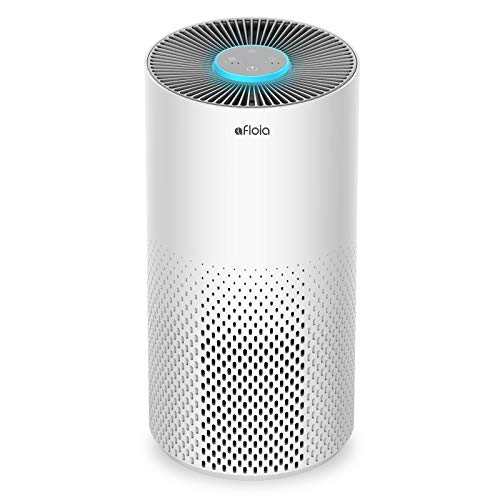
Afloia Air Purifier for Home Bedroom Large Room up to 1500 Sq Ft
- washable pre-filter
$59.97 Check pricePrices change often - Afloia
Afloia Air Purifier for Home Bedroom Large Room up to 1076 Sq Ft
$69.98 Check pricePrices change often - Afloia
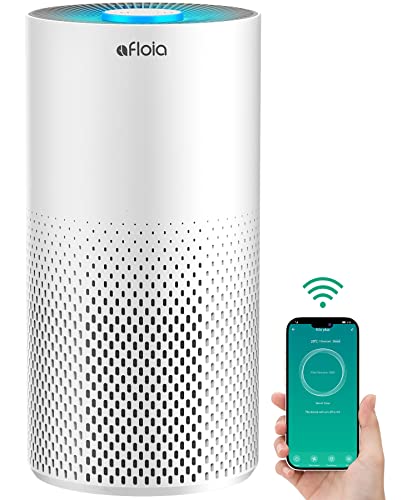
Afloia Smart Air Purifier for Home Large Rooms Bedroom, Up to 1,076 sq ft
- app or voice
$69.99 Check pricePrices change often




Common questions
What is a good ACH for a bedroom?
Most guidance points to 4 to 5 air changes an hour for a bedroom, higher if someone in the household has allergies or lives with a pet that sheds. That figure is guidance, not a published standard, and it is the same air change rate behind the common two thirds CADR sizing rule at an 8 foot ceiling.
Is a higher ACH always better?
Higher ACH clears particles faster, but the gains shrink past roughly 5 to 6 changes an hour, while fan noise and energy draw keep climbing. Past that point, most households are better served by placement, filter condition, and closing the loop with the source of the particles than by chasing a higher ACH number.
How is ACH different from CADR?
CADR is a fixed number printed on a specific machine, measured in cubic feet per minute under the AHAM AC-1 standard. ACH is a rate that depends on both that CADR figure and the room it is placed in: the same CADR number produces a high ACH in a small room and a low ACH in a large one.
Does ACH account for doors and airflow in a real house?
No. The ACH formula assumes a sealed, well-mixed room with the purifier as the only source of filtered air movement. An open doorway, a running HVAC return, or a poorly placed unit in a corner will all push actual performance below the number the formula predicts.
Why does 138 minutes at 1 ACH sound so slow?
Because clearing 90 percent of particles at a low air change rate is genuinely slow: the room’s air is only being filtered once every 60 minutes, so meaningful reduction takes multiple cycles to compound. This is the practical case for sizing toward 4 to 5 ACH rather than accepting whatever a small, underpowered machine happens to deliver in a given room.
What ACH do wildfire smoke guides usually recommend?
Guidance for active wildfire smoke events commonly points to 5 to 6 air changes an hour or higher, above the everyday allergy guidance range, because smoke particles are continuously entering from outside air infiltration rather than settling once. `/problems/wildfire-smoke/` covers sizing for that specific situation.