Dust and dust mites: why vacuuming matters more than filtering
Quick answer
Dust mite allergen is concentrated in mattresses, bedding, carpet and upholstery, and it is heavy enough to settle back out of the air within minutes of being disturbed, so vacuuming and washing bedding remove more of it than any purifier running in the same room. A true HEPA and carbon unit like the GermGuardian AC4825, rated for 153 sq ft at $80.74, still helps with the finer, longer-suspended dust fraction.

GermGuardian HEPA Air Purifier - Large Room Air Purifier for Bedroom, Office, Dorm, and Home - Filters Pet Dander, Dust, Pollen, Smoke, Scents - AC4825E - 22" Tower - Gray
The AC4825 covers a bedroom-sized 153 sq ft with true HEPA and a carbon layer, and it is a well-established, affordably priced unit for the fine airborne dust fraction that vacuuming does not reach. It also has a UV-C stage that can be switched off entirely, since the true HEPA filtration is what does the actual particle removal.
Coverage claims vary in what air change rate they assume, so check a published airflow figure against your own room rather than the room size on the box.
| Particle type | Typical behavior once airborne |
|---|---|
| Dust mite allergen fragments | Relatively heavy; settles back out within minutes of disturbance |
| Skin cells and larger fibers | Heavy; settles quickly onto nearby surfaces |
| Fine dust and smoke-sized particles | Light; stays suspended for hours without filtration or airflow |
What is household dust actually made of?
Ordinary household dust is a mix of shed skin cells, textile fibers, soil tracked in from outside, pet dander where pets are present, and the dried fecal fragments and body parts of dust mites, microscopic organisms that live on shed skin cells in mattresses, pillows, carpet and upholstered furniture. The dust mite fragments and waste are the part most closely associated with allergen exposure, and unlike smoke or fine combustion particles, they are relatively heavy.
That weight matters directly for how the problem should be approached. Heavier particles do not stay suspended in room air the way lighter, finer particles do; they settle back onto surfaces within minutes of being stirred up, whether by walking across a carpet, shaking out bedding or vacuuming without a sealed filter.
Where do dust mites actually live, and why does that matter for filtration?
Dust mites concentrate in mattresses, pillows, bedding, upholstered furniture and carpet, places with a steady supply of shed skin cells and the humidity they need to survive. They are not primarily an airborne population; they live embedded in fabric and settle-out dust, which means the majority of dust mite allergen exposure happens through direct contact with those surfaces, not through breathing continuously circulating room air the way pollen or smoke exposure works.
This is the key difference from a problem like wildfire smoke or pollen: a purifier’s CADR only affects what is airborne at a given moment, and dust mite allergen spends most of its time settled rather than airborne, so the purifier is working on a smaller share of the total problem than it would for a lighter, longer-suspended particle.
Does an air purifier meaningfully reduce dust mite exposure?
It reduces the airborne fraction while it is actually suspended, such as right after making a bed or vacuuming a rug, when disturbed allergen briefly becomes airborne before settling again. A true HEPA unit running continuously captures some of that transient airborne load, but because most dust mite allergen spends its time settled on fabric and carpet rather than floating in the room, filtration alone leaves the larger share of the exposure untouched.
What actually reduces dust mite exposure more than a purifier?
Washing bedding weekly in hot water, using allergen-proof encasements on mattresses and pillows, and vacuuming carpet and upholstery with a machine that has a sealed HEPA filter, so it does not exhaust fine dust back into the room, all directly remove settled allergen rather than waiting for it to become airborne first. Keeping indoor relative humidity below 50 percent also matters, since dust mites need humidity above roughly that level to thrive, and a drier room slows their population growth at the source.
None of these steps require giving up on a purifier; they simply address the larger, settled share of the problem that filtration by itself cannot reach.
Where does a purifier still genuinely help with household dust?
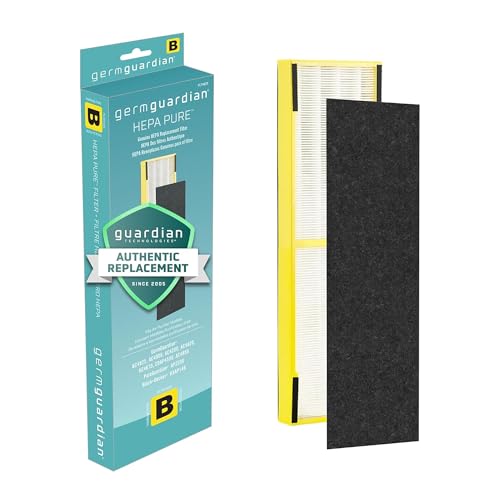
The finer fraction of household dust, including smaller mineral and combustion particles that behave more like smoke than like heavy dust mite fragments, does stay suspended for hours and is exactly what a true HEPA purifier is built to capture continuously. A bedroom-sized unit running overnight reduces that finer fraction the same way it would for pollen or dander, even while the heavier dust mite allergen mostly needs to be vacuumed and washed away instead. The AC4825’s genuine replacement filter runs about $19.88, a modest recurring cost against a filter that is doing real, continuous work on the fine fraction every day.
Equipment mentioned on this page
- Borgodf
Borgodf B-D02L/M05 Replacement Filter for MOOKA B-D02L & M05 Air Purifier
- HEPA claimed
- carbon stage
$17.98 Check pricePrices change often - Sinnya
12020 11020 HEPA Replacement Filter for Clorox Air Purifier 11020 & 11021
- HEPA claimed
$19.66 Check pricePrices change often - Cabiclean
Blue Pure Replacement Filter for Blueair 411, 411+, 411 Auto Air Purifier
- carbon stage
$19.89 Check pricePrices change often - Clorox
Clorox Tabletop Air Purifier True HEPA Replacement Filter, 200 Sq. Ft.
- HEPA claimed
$19.99 Check pricePrices change often - Borgodf
2 Pack HP102 Replacement Filter Compatible with Shark HP102 Air Purifier
- HEPA claimed
- carbon stage
$21.37 Check pricePrices change often




Common questions
Does an air purifier remove dust mites themselves from a room?
No. Dust mites live embedded in mattresses, bedding, carpet and upholstery rather than floating in room air, so a purifier does not reach the mites or most of their waste directly. It can capture some of the allergen that briefly becomes airborne when fabric or carpet is disturbed, but the mites and the bulk of their settled waste stay where they are until physically removed.
Is vacuuming or an air purifier more effective for dust mite allergy exposure?
Vacuuming, along with washing bedding and using allergen-proof encasements, addresses the larger settled share of dust mite allergen directly. A purifier only affects the smaller airborne fraction at any given moment. The two are not competing solutions; a household dealing with dust mites gets more benefit from vacuuming and washing than from filtration alone.
Does lowering indoor humidity actually reduce dust mites?
Yes, because dust mites need a certain humidity level, generally above around 50 percent, to survive and reproduce. Keeping indoor relative humidity below that threshold slows their population growth over time, which is a source-control approach rather than a filtration one, and it works alongside vacuuming and washing rather than replacing them.
Should the UV-C mode on a purifier be left on for dust mite control?
It makes no meaningful difference to dust mite allergen removal either way, since the true HEPA filtration stage is what actually captures airborne particles. Where a unit has a UV-C mode, it can be switched off without reducing dust mite allergen removal, since the mechanical filtration is doing the actual work regardless of the UV setting.
How often should mattress and pillow encasements be washed for dust mite control?
Following the manufacturer’s washing instructions, typically every few months, keeps an encasement effective at blocking allergen from passing through the fabric. The encasement itself does most of the work by sealing off the mattress surface; washing it periodically maintains that seal rather than needing to happen as often as regular bedding.
Does carpet make a dust mite problem worse than hard flooring?
Carpet holds more settled dust and allergen than hard flooring because its fibers trap particles that would otherwise be easier to wipe or vacuum off a smooth surface. Regular vacuuming with a sealed HEPA filter reduces that buildup significantly, but hard flooring with area rugs that get washed is generally easier to keep lower in settled allergen than wall-to-wall carpet.