Best air purifiers for wildfire and indoor smoke
Quick answer
Size a smoke purifier to 6 air changes an hour instead of the usual 4 to 5, because smoke keeps entering a room while the machine removes it; the Medify MA-40 (B07LGDYV3C) covers about 1,494 square feet at that rate.
Smoke CADR is the AHAM number to check first: it is almost always the lowest of a purifier’s three published ratings, and it is the one most shoppers skip past.

Medify MA-40 Air Purifier with HEPA Filter | 1,793 ft2 Coverage in 1hr for Smoke, Wildfires, Odors, Pollen, Pets | Quiet Removal to 0.3 Microns | White, 1-Pack
The Medify MA-40 carries a true HEPA filter and a coverage claim built around wildfire smoke, not general dust. Run the two-thirds convention’s numbers up from 5 to 6 air changes an hour and it still clears a room near 1,494 square feet.
Coverage claims vary in what air change rate they assume, so check a machine's published airflow against your own room rather than the room size on the box.
The three tiers
Beginner: Best first smoke purifier
Who it is for: a single bedroom or home office that gets smoky a few weeks a year
- Beginner pick
MOOKA H13 HEPA Air Purifier for Home Pet Large Room Up to 1300ft2, Black
- HEPA claimed
- carbon stage
- has a UV lamp
$46.98 Check pricePrices change often

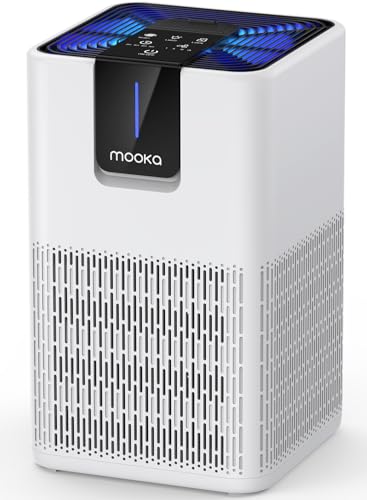
The MOOKA H13 HEPA (B0CP7QSRHV) claims 1,300 square feet, true HEPA plus a carbon stage for the burnt smell, at $46.98. Adjusted to 6 air changes an hour that is closer to 1,083 square feet, still enough for most bedrooms.
Not for: a whole floor of open-plan living space during a multi-week smoke event
Intermediate: Best for a full smoke season
Who it is for: a living room that needs to run for weeks without the filter clogging
- Intermediate pick
- HEPA claimed
- particle sensor
- auto mode
- app or voice
$179.99 Check pricePrices change often

The Winix 5510 (B0DJG1731C, the current generation of the well-reviewed 5500-2) adds a particle sensor and app control for $179.99. Its 1,881 square foot claim becomes about 1,568 square feet once the math is redone at 6 air changes an hour.
Not for: rooms much larger than about 1,500 square feet on a single unit
Expert: Best for heavy or repeated smoke seasons
Who it is for: a large open floor or a household that gets wildfire smoke most years
- Expert pick
BLUEAIR Air Purifiers for Home Large Room up to 3,235 Ft2, Blue 211i Max
- particle sensor
$349.00 Check pricePrices change often
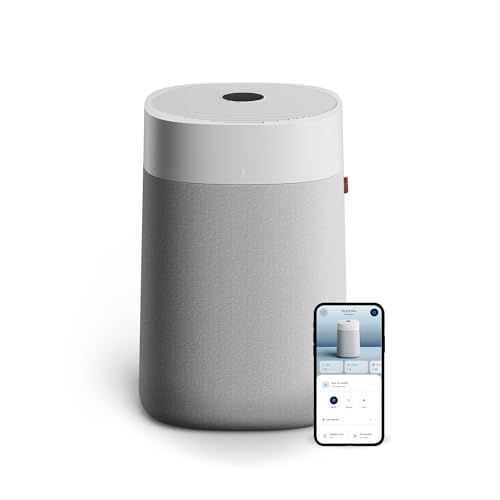
The Blueair 211i Max (B0BN2MGV5H, $349.00) has the largest claimed coverage in this lineup at 3,235 square feet and a built-in particle sensor. At 6 air changes an hour that works out to roughly 2,696 square feet, still the biggest number here.
Not for: anyone on a tight budget or filtering a single small room
| Tier | Manufacturer claim | Redone at 6 ACH |
|---|---|---|
| Beginner (MOOKA H13, B0CP7QSRHV) | 1,300 sq ft | ~1,083 sq ft |
| Intermediate (Winix 5510, B0DJG1731C) | 1,881 sq ft | ~1,568 sq ft |
| Expert (Blueair 211i Max, B0BN2MGV5H) | 3,235 sq ft | ~2,696 sq ft |
| Top pick (Medify MA-40, B07LGDYV3C) | 1,793 sq ft | ~1,494 sq ft |
Why does smoke need more air changes an hour than allergies?
Smoke keeps arriving. A wildfire event or a wood stove can push new particulate into a room continuously, so the purifier is racing an active source instead of cleaning up a fixed batch of pollen that settled overnight. Six air changes an hour is the target this page uses for that reason, a step up from the four to five used for allergy guidance elsewhere on this site.
The required CADR in CFM is floor area times ceiling height times air changes an hour, divided by 60. A 150 square foot bedroom with an 8 foot ceiling needs 150 x 8 x 6 / 60, which is 120 CFM of smoke CADR. Run the same room through the two-thirds convention, which bakes in 8 foot ceilings and 5 air changes an hour, and it only calls for 100 CFM. That 20 percent gap is the cost of an active smoke source, and it grows further in a room with a higher than 8 foot ceiling, since the extra air volume needs proportionally more CADR at either air change rate.
Which CADR number actually matters for smoke?
AHAM AC-1 is the standard: a sealed 1,008 cubic foot test chamber produces three separate CADR numbers, for smoke, dust and pollen. Smoke particles are the smallest of the three the standard measures, and the smoke CADR is usually the lowest number printed on the box or spec sheet. Shoppers who check only the largest number on a listing are checking the wrong one.
A unit with a strong dust CADR and a mediocre smoke CADR will undersize badly for a wildfire event even though its marketing copy looks impressive. When a listing states all three AHAM numbers, use the smoke figure for the arithmetic above. When it only states one number without naming which particle it covers, treat the coverage claim skeptically rather than assuming it is the smoke rating. This gap between the three CADR numbers is not a manufacturing defect; smoke particles are genuinely harder to capture at high volume than the coarser dust and pollen particles the same filter media handles more easily.
What does a manufacturer’s square footage claim assume?
A coverage claim in square feet means nothing without the air change rate it assumes, and most manufacturer claims lean on something close to the two-thirds convention’s 5 air changes an hour with an 8 foot ceiling. That convention is a shopper’s rule of thumb, not a test standard, and it undersizes for smoke on purpose because smoke needs 6.
Multiplying a claimed figure by 5/6 gives a smoke-honest number without needing the manufacturer’s underlying test data. The same physical machine advertised at 500 square feet under a slower assumed change rate can honestly cover closer to 417 square feet once smoke’s faster requirement is applied, and the table above works through that math for each pick on this page. Keeping that adjustment in mind before comparing two listings side by side avoids the common mistake of picking the unit with the bigger printed number rather than the one that actually clears smoke faster in the room it will sit in.
Is an ionizer or UV mode worth it for smoke odor?
No, and this is the point where this site is direct: ozone generators are harmful in occupied rooms, and ionizer or plasma modes that add ions to the air can produce ozone as a by-product. California’s CARB regulates ozone emissions from indoor air cleaning devices for this reason. None of the picks on this page should be run with an ionizer or UV mode engaged for smoke odor control.
Where a listed unit has a switchable ionizer or UV stage, such as some MOOKA models in this lineup, leave it off. The true HEPA filter and the carbon stage are doing the actual work of removing particulate and adsorbing odor compounds; the extra mode is not adding filtration capacity and is not worth the tradeoff.
How fast will a purifier actually clear smoke from a room?
For a well-mixed room where the purifier is the only removal path, time to clear 90 percent of airborne particulate is t = ln(10) / ACH hours. At 6 air changes an hour that works out to about 23 minutes; at 4 air changes an hour, the allergy-guidance rate, it stretches to roughly 34 and a half minutes.
That gap compounds during an active smoke event, because new particulate keeps entering the room through door gaps and air exchange with outside air. A machine sized correctly for 6 air changes an hour is not just faster in a lab sense, it is the difference between staying ahead of a continuous source and slowly losing ground to it. A room sealed as tightly as practical, doors closed and obvious gaps addressed, gives the purifier a fairer fight against outside infiltration, though no ordinary room seals perfectly enough to remove air exchange from the equation entirely.
Should a carbon stage be part of a smoke purifier?
A true HEPA filter captures particulate, but the burnt smell that lingers after a wildfire event or a wood stove session is largely volatile compounds, not particulate, and HEPA media does not adsorb those. A carbon stage, even a modest one bundled into a combination filter, is what pulls odor compounds out of the air alongside the particulate removal.
Every pick in the Beginner, Intermediate and Expert tiers on this page carries a carbon stage in addition to true HEPA media. That combination, not either stage alone, is why they are recommended here for smoke specifically rather than for allergy-only households. A HEPA-only unit will still show a clean particle count on a monitor while the room smells strongly of smoke, which is the gap a carbon stage is there to close, and it is a gap a shopper only notices after buying if the carbon stage was never checked for at the point of purchase.
Does running one large purifier beat splitting coverage across two smaller ones?
For a single open room, one correctly sized unit is simpler than two smaller machines: it means one carbon-and-HEPA filter to track, one sensor reading the room, and no risk of the two units disagreeing about auto mode settings. The Expert tier pick on this page, with the largest coverage claim in the lineup, is built for exactly that single-room case.
Splitting coverage across two smaller purifiers makes more sense across genuinely separate spaces, such as a bedroom and a home office on opposite sides of a house, where a single central unit would leave one room under-served during an active smoke event. Adding CADR from two units in the same open room is possible in principle, but the arithmetic in the sections above is written around a single machine and a single sensor reading, and stacking units complicates both without a clear benefit in a room that one correctly sized purifier already covers. Buying two mid-tier units for the price of one large one rarely beats simply buying the larger unit outright once that extra complexity is weighed against it.
How we chose
Every product on this page was researched from published manufacturer specifications, AHAM-reported CADR figures where a listing states them, and owner reports on retail listings, not from in-person or lab testing of any kind.
Selection prioritized true HEPA media, a carbon stage for odor, and a manufacturer coverage claim large enough to still clear a realistic room once redone at 6 air changes an hour instead of the slower rate most coverage claims assume.
Buying tips
Should I trust the square footage number on the box?
Only after checking what air change rate it assumes. Most claims lean on a slower rate than smoke needs, so the honest coverage number for smoke is usually 15 to 20 percent smaller than the printed figure.
Does a bigger purifier always mean better smoke protection?
Only if its smoke CADR, not its dust or pollen CADR, actually supports the room’s size at 6 air changes an hour. A large cabinet with a weak smoke rating will underperform a smaller unit built around true HEPA and carbon.
Is a HEPA filter enough on its own during a wildfire event?
For particulate, yes. For the smell that comes with it, a carbon stage is doing separate work that HEPA media cannot do, which is why every pick here combines both.
Other options worth knowing about
- MOOKA
MOOKA Air Purifiers for Home Room up to 1076ft2, True HEPA Filter, B-D02L
- HEPA claimed
- carbon stage
$49.99 Check pricePrices change often - MOOKA
MOOKA Air Purifiers for Home Room up to 1076ft2, True HEPA Filter, B-D02L
- HEPA claimed
- carbon stage
$49.99 Check pricePrices change often - MOOKA
Air Purifiers for Home Large Room 1250 Ft2, MOOKA H13 HEPA Filter M05 White
- HEPA claimed
$66.63 Check pricePrices change often



Worth knowing before you buy
Common questions
Why does this page use 6 air changes an hour instead of the usual 4 to 5?
Smoke is an active, continuing source rather than a fixed batch of settled particulate. Because new smoke keeps entering a room during a wildfire event or while a wood stove runs, the purifier needs a faster turnover rate to stay ahead of it, which is why this page targets 6 air changes an hour instead of the 4 to 5 used for allergy guidance.
Which CADR number should I check for a wildfire smoke purifier?
Check the smoke CADR specifically, one of the three numbers AHAM AC-1 testing produces alongside dust and pollen. Smoke particles are the smallest of the three the standard measures, so the smoke figure is usually the lowest number on a spec sheet. A large dust CADR does not tell you how the unit performs against smoke.
Is it safe to leave a purifier’s ionizer or UV mode on during wildfire smoke?
It is better left off. Ionizer and some plasma or UV modes can produce ozone as a by-product, and ozone is harmful in occupied rooms; California’s CARB regulates ozone emissions from indoor air cleaning devices for that reason. True HEPA filtration and a carbon stage do the actual removal work without that tradeoff.
Does a HEPA filter remove the smell of smoke, not just the particulate?
Not on its own. HEPA media captures particulate matter but does not adsorb the volatile compounds responsible for smoke odor. A carbon stage, present in every purifier recommended on this page, is what removes odor compounds, so a smoke purifier needs both stages rather than HEPA alone, which is why coverage and CADR are not the only specs worth checking before buying.
How long does it take a purifier to clear smoke from a room?
For a well-mixed room with no other removal path, time to reach 90 percent clearance is roughly ln(10) divided by the air change rate, in hours. At 6 air changes an hour that is about 23 minutes; at a slower 4 air changes an hour it stretches past 34 minutes, and an active smoke source extends that further.
Why does a purifier’s coverage claim shrink when I redo the math for smoke?
Manufacturer square footage claims typically assume a slower air change rate than smoke needs, often close to the 5 air changes an hour built into the two-thirds shopping convention. Multiplying the claimed figure by 5/6 gives a coverage number consistent with the faster 6 air changes an hour this page recommends for active smoke.