Air purifier vs opening a window
Quick answer
Opening a window is the better fix for carbon dioxide buildup and indoor VOCs, because dilution with outdoor air is the only way to remove a gas; an air purifier is the better fix for particulate like wildfire smoke, pollen, or dust, and on a smoke day opening a window makes indoor air worse, not better.

Levoit Smart Air Purifiers for Home Large Room up to 2933 Ft2, Core 600S-P
On a wildfire smoke day, a high-CADR purifier like the Levoit Core 600S-P (391 CFM CADR) is the right call specifically because opening a window pulls in the same particulate you are trying to remove.
Coverage claims vary in what air change rate they assume, so check a published airflow figure against your own room rather than the room size on the box.
| Problem | Ventilation (open window) | Filtration (air purifier) |
|---|---|---|
| Carbon dioxide buildup | Fixes it: dilutes with outdoor air | Does nothing: a filter does not remove CO2 |
| VOCs from paint, new furniture, cleaners | Fixes it: gas leaves with the air exchange | Only helps if the unit has an activated carbon stage |
| Wildfire smoke outside | Makes it worse: brings outdoor particulate in | Fixes it: HEPA filtration removes the particulate |
| Seasonal pollen | Makes it worse during high pollen hours | Fixes it: HEPA filtration removes particulate |
| Cooking smoke and odor | Helps: clears the gas and steam quickly | Helps: carbon for odor, HEPA for particulate |
| Musty, damp basement smell | Limited: only helps if outdoor humidity is lower | Does nothing for the moisture source; needs a dehumidifier |
Why a filter cannot fix carbon dioxide
Carbon dioxide is a gas, and a HEPA filter is built to trap particles by physically catching them in a mesh of fibers. Gas molecules pass straight through that mesh; there is nothing for them to collide with or stick to. This is true no matter how expensive or well rated the purifier is. The only ways to reduce indoor CO2 are to bring in outdoor air, which dilutes the concentration, or to reduce the number of people and combustion sources adding CO2 to the room in the first place.
A rising CO2 reading in a bedroom overnight, especially with the door closed and multiple people or pets sleeping in it, is a ventilation problem specifically, and cracking a window is the direct fix. Running a purifier harder in that same room changes nothing about the CO2 number, because that number was never about particulate.
Why VOCs need dilution, not filtration, in most cases
Volatile organic compounds off-gas from paint, new furniture, flooring adhesive, and many cleaning products. Like CO2, VOCs are gas phase, not particulate, and a standard HEPA filter does not remove them. The exception is a purifier with a genuine activated carbon stage, where the gas molecules are adsorbed onto the surface of the carbon rather than passing through untouched.
Even a good carbon stage has a mass limit: a thin carbon layer bundled into a combination filter saturates faster than a filter built around a larger dedicated carbon mass. For a fresh paint job or new furniture off-gassing, ventilation is faster and does not depend on how much carbon media happens to be in your purifier.
Why the window is the wrong move on a smoke day
Wildfire smoke, unlike CO2 or indoor VOCs, is a particulate problem originating outdoors. Opening a window on a smoke day does the opposite of what you want: it lets the same fine particulate you are trying to avoid flow directly into the room. This is the one scenario in this comparison where ventilation actively makes the air worse rather than doing nothing.
A sealed room running a HEPA purifier is the correct response to outdoor smoke, pollen, or dust events. The CADR number for that purifier tells you how fast it can turn over the air in a given room; a higher CADR unit reaches a clean baseline faster and holds it better against whatever particulate is finding its way in through door gaps and normal air exchange.
How fast a purifier actually clears a room once it is sealed
Once a room is sealed against outdoor smoke or pollen and a purifier is the only removal path, the time to clear most of the particulate follows a predictable curve rather than a fixed number of minutes. The time to remove 90 percent of airborne particles in a well mixed room, with the machine as the only removal path, works out to about ln(10) divided by the air changes per hour, which is roughly 138 minutes at 1 air change an hour and about 28 minutes at 5 air changes an hour.
This is guidance, not a certified test result, but it explains why undersizing a purifier for a smoke event matters more than undersizing it for everyday dust: at 1 ACH you are waiting over two hours to reach a 90 percent reduction, while at 5 ACH the same reduction takes under half an hour. A unit with enough CADR to hit 4 to 5 air changes an hour for your room, the same guidance figure used for allergy households, clears a smoke-filled room meaningfully faster than one sized only for baseline dust. Door and window gaps still let some outdoor air leak in even with everything closed, which is why a higher CADR unit holding a lower baseline against that leakage matters more during an extended smoke event than a single fast initial clearing.
Pollen and seasonal allergies complicate the simple answer
Pollen behaves like wildfire smoke in one respect and unlike it in another. Like smoke, pollen mostly originates outdoors, so opening a window during a high pollen count brings more of it in rather than clearing anything out, the same logic that applies on a smoke day. Unlike smoke, pollen counts vary through the day, typically peaking in mid-morning and again around dusk depending on the plant source and local conditions, which means a window opened during a low-count window does less harm than one left open all day.
For anyone managing seasonal allergies specifically, treating pollen like a particulate problem, meaning keeping windows closed during peak hours and relying on a HEPA purifier indoors, is generally more effective than treating it like a general air freshness problem that ventilation would solve.
The trade-off ventilation carries that filtration does not
Opening a window does not just exchange air, it exchanges temperature and humidity along with it. In winter, ventilating for CO2 or VOC relief means losing conditioned heat and can drop indoor relative humidity further, which matters if the room is already below the 30 to 50 percent target range. In summer, the same open window undoes air conditioning and can raise indoor humidity if outdoor air is more humid than what the AC has been removing.
A HEPA purifier has no such trade-off: running it does not change indoor temperature or humidity at all, since it recirculates and filters the air already in the room rather than exchanging it with outside. This is part of why filtration is the better year-round default for particulate problems specifically, while ventilation is reserved for the gas-phase problems that actually require an exchange with outside air to solve. A purifier does add a small, continuous electricity cost of its own, but that cost does not compound with your heating or cooling bill the way an open window does.
Reading the room instead of guessing
The fastest way to know which problem you actually have is a monitor that reports both. A CO2 monitor answers whether a stuffy bedroom needs a cracked window; a PM2.5 reading answers whether outdoor smoke or indoor cooking is the particulate source. Guessing which lever to pull without a number in front of you means you might run a purifier all night against a CO2 problem it cannot touch, or crack a window during a smoke event it cannot help. A few dollars spent on a basic monitor pays for itself the first time it saves you from picking the wrong fix on a night that actually mattered.
A cheap rule of thumb: if the air feels stuffy or a headache sets in in a closed room with people in it, suspect CO2 and ventilate. If the air smells or looks hazy and the source is outside, suspect particulate and seal up, run the purifier, and skip the window until conditions clear. A monitor like the Aranet4 gives you a specific CO2 number rather than a guess based on how the room feels, which matters most in a bedroom where the door stays closed for eight hours at a stretch.
Equipment mentioned on this page
- MOOKA
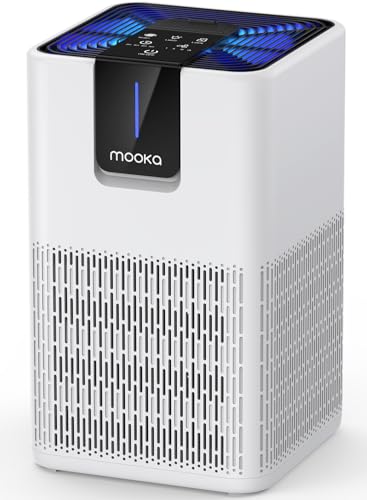
MOOKA H13 HEPA Air Purifier for Home Pet Large Room Up to 1300ft2, Black
- HEPA claimed
- carbon stage
- has a UV lamp
$46.98 Check pricePrices change often - MOOKA
MOOKA Air Purifiers for Home Room up to 1076ft2, True HEPA Filter, B-D02L
- HEPA claimed
- carbon stage
$49.99 Check pricePrices change often - MOOKA
MOOKA Air Purifiers for Home Room up to 1076ft2, True HEPA Filter, B-D02L
- HEPA claimed
- carbon stage
$49.99 Check pricePrices change often - MOOKA
Air Purifiers for Home Large Room 1250 Ft2, MOOKA H13 HEPA Filter M05 White
- HEPA claimed
$66.63 Check pricePrices change often


Common questions
Can I run a purifier and open a window at the same time?
You can, but on any day when outdoor air quality is worse than indoor, an open window undercuts what the purifier is doing by continuously adding new particulate for it to filter. On days when outdoor air is clean, ventilating while running the purifier is fine and helps with both particulate and gas-phase problems at once.
Does an air purifier remove carbon dioxide at all?
No. Standard air purifiers, including true HEPA and activated carbon models, are not built to remove carbon dioxide. CO2 is a gas that passes through particulate filters and is not adsorbed by activated carbon the way VOCs are. Reducing CO2 requires bringing in outdoor air or reducing occupancy in the space.
Is it safe to open windows during wildfire smoke events?
Generally no, if outdoor air quality is degraded by smoke. Opening windows during a smoke event brings the same fine particulate indoors that a sealed room with a running purifier is designed to keep out. Check a local air quality index reading before deciding, and keep windows closed when outdoor PM2.5 is elevated.
How do I know if my indoor air problem is CO2 or particulate?
A dedicated CO2 monitor and a PM2.5-reporting air quality monitor answer this directly. Stuffiness, drowsiness, or headaches in a closed occupied room point toward CO2. Visible haze, a smoke smell, or a rising PM2.5 number point toward particulate. Without a monitor, you are guessing which lever actually helps.
Does opening a window help with cooking smoke?
Yes, ventilation clears cooking smoke and steam quickly by exchanging the air directly, and it works whether the smoke is particulate, gas, or both. A purifier with both HEPA and carbon stages also helps, but ventilation is typically faster for an acute cooking event.