Match CADR to room size: coverage at 2, 4.5, and 6 air changes per hour
Quick answer
A purifier with 200 CADR covers 750 square feet at 2 air changes an hour, 333 square feet at 4.5 changes per hour, and 250 square feet at 6 changes per hour. Choose the row that matches your target air change rate.

MOOKA Air Purifiers for Home Room up to 1076ft2, True HEPA Filter, B-D02L
A machine that publishes a real airflow figure, so the arithmetic on this page can actually be applied to it.
Coverage claims vary in what air change rate they assume, so check a published airflow figure against your own room rather than the room size on the box.
| CADR (CFM) | At 2 ACH | At 4.5 ACH | At 6 ACH |
|---|---|---|---|
| 50 | 187 sq ft | 83 sq ft | 62 sq ft |
| 75 | 281 sq ft | 125 sq ft | 94 sq ft |
| 100 | 375 sq ft | 167 sq ft | 125 sq ft |
| 125 | 469 sq ft | 208 sq ft | 156 sq ft |
| 150 | 562 sq ft | 250 sq ft | 187 sq ft |
| 175 | 656 sq ft | 292 sq ft | 219 sq ft |
| 200 | 750 sq ft | 333 sq ft | 250 sq ft |
| 250 | 937 sq ft | 417 sq ft | 312 sq ft |
| 300 | 1,125 sq ft | 500 sq ft | 375 sq ft |
| 350 | 1,312 sq ft | 583 sq ft | 437 sq ft |
| 400 | 1,500 sq ft | 667 sq ft | 500 sq ft |
Understanding the three air change rates
CADR is the Clean Air Delivery Rate in cubic feet per minute, measured under the AHAM AC-1 standard in a sealed test chamber. To translate CADR to a room size, you need to know how many times per hour the air should be completely replaced.
Air change rate, abbreviated ACH, is the number of times per hour that all the air in a room is exchanged. At 2 ACH, the air is completely replaced twice per hour, or every 30 minutes. At 6 ACH, the air is replaced six times per hour, or every 10 minutes.
The difference between these rates matters: two air changes per hour is the minimum to reduce allergens, pollen, and dust mites over a day. Four and a half to five air changes per hour is the standard for allergy households, recommended by the American College of Allergy, Asthma and Immunology. Six air changes per hour or higher is used for smoke or wildfire events.
Which air change rate is right for you
- 2 ACH: General air quality maintenance in a bedroom or office with no specific pollution source.
- 4.5 ACH: Allergy, asthma, or dust mite households, or regular indoor cooking smoke.
- 6 ACH or higher: Wildfire smoke, active cooking smoke, or severe indoor pollution.
How to use this chart to size a purifier
Step one: measure your room floor area in square feet. Multiply length times width. If the room is not rectangular, divide it into rectangles.
Step two: decide which air change rate you need based on pollution sources. If you have pets and allergies, use 4.5 ACH. If you cook regularly or live near wildfires, use 4.5 to 6 ACH.
Step three: find the row in the chart where the ACH column matches your target, and read across to find the closest room size. The CADR column on the left tells you the minimum CADR you need.
For example, a 300 square foot bedroom with allergy concerns (4.5 ACH) needs a purifier with at least 200 CADR. A 500 square foot living room with regular cooking needs 300 CADR at 4.5 ACH.
The math behind CADR to room size
The formula is straightforward: Room size in square feet = (CADR in CFM × 7.5) divided by ACH.
This comes from the definition of air change rate. If a room has one air change per hour (1 ACH), the purifier delivers a volume of air equal to the room size, every hour. For an 8-foot ceiling, that volume is floor area (sq ft) times 8 (ft). At 60 minutes per hour, CFM equals floor area times 8 divided by 60. Rearranging: floor area = CFM times 60 divided by 8, which simplifies to CFM times 7.5.
Divide by the target ACH, and you get the room size the CADR can support at that rate. This arithmetic matches the calculators on the site.
What happens if you underscore CADR
Underscoring CADR means the purifier delivers fewer air changes per hour than intended. At 3 ACH instead of 4.5, the effective room coverage shrinks by a third. The purifier still removes particulate, but it takes longer to reach steady state.
In a real room with continuous pollution (cooking, smoke), undersized purifiers fall behind. The indoor PM2.5 does not drop as fast, and on heavy pollution days, it climbs faster than the purifier can clear it.
Oversizing CADR is cheap insurance. A 200 CADR unit in a 200 square foot room at 4.5 ACH delivers 6 ACH instead, clearing the air twice as fast. The cost is higher energy use, which is why running on low speed saves money if AQI is moderate.
Multiple units in larger spaces
A 1,200 square foot open living area cannot be served by a single 200 CADR purifier at 4.5 ACH (which covers 333 sq ft). You need either a single 900+ CADR unit, or two to three medium units placed apart.
Two smaller units placed on opposite ends of the room will maintain lower concentrations than one large unit in a corner, because they distribute purified air more evenly. The standard practice in large spaces is to run multiple units rather than one oversized unit.
Equipment mentioned on this page
- MOOKA
MOOKA H13 HEPA Air Purifier for Home Pet Large Room Up to 1300ft2, Black
- HEPA claimed
- carbon stage
- has a UV lamp
$46.98 Check pricePrices change often - MOOKA
MOOKA Air Purifiers for Home Room up to 1076ft2, True HEPA Filter, B-D02L
- HEPA claimed
- carbon stage
$49.99 Check pricePrices change often - Clorox
Clorox Small Room Air Purifiers for Bedroom Home, True HEPA Filter
- HEPA claimed
$59.95 Check pricePrices change often - Frida
Frida Baby 3-in-1 Air Purifier, Sound Machine + Nightlight, Auto-Off Timer
- HEPA claimed
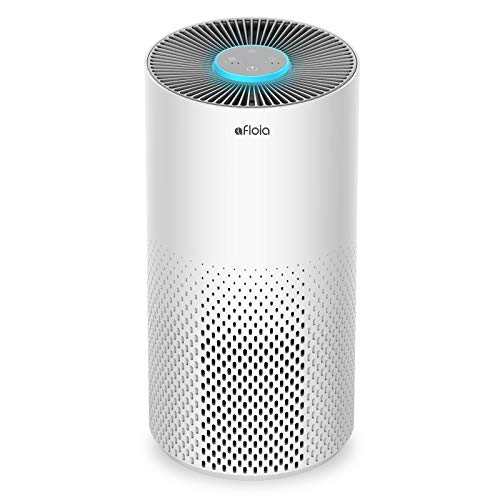
$59.97 Check pricePrices change often - Afloia
Afloia Air Purifier for Home Bedroom Large Room up to 1500 Sq Ft
- washable pre-filter
$59.97 Check pricePrices change often


Common questions
Why is the formula CADR × 7.5 ÷ ACH?
The 7.5 comes from ceiling height. Volume equals floor area times height. At 8 feet tall, that is area times 8. Air change rate happens over 60 minutes, so CFM times 60 seconds per minute divided by 8 feet equals area times 7.5. Divide by the target ACH and you have room coverage.
My purifier lists coverage, not CADR. Can I use the coverage claim instead?
Coverage claims are manufacturer estimates and do not always match the standard formula. A unit claiming 500 square feet often assumes 2 ACH, not 4.5. Look for CADR instead: it is the measured standard. If only coverage is listed, ask the manufacturer for CADR.
Should I size for 2 ACH or 4.5 ACH?
Two ACH is minimum for general air quality improvement. Four and a half ACH is the recommendation for allergy households from the American College of Allergy, Asthma and Immunology. If you have allergies, pets, or regular indoor pollution, use 4.5. For bedrooms in low-pollution areas, 2 to 3 ACH is acceptable.
Does a smaller purifier in a larger room help at all?
Yes, but it is slower. A 150 CADR purifier in a 400 square foot bedroom at 4.5 ACH delivers only 1.7 air changes per hour. It still removes particulate, but it takes 3 to 4 hours to reach steady state instead of 1 to 2 hours. For acute pollution like cooking smoke, it will not keep up.
What if my ceiling is 9 feet, not 8?
The chart assumes 8-foot ceilings, which is standard. For 9 feet, multiply CADR by 9 divided by 8 (about 1.1), or divide room size by 1.1. For 7 feet, divide CADR by 1.14 or multiply room size by 0.875. The adjustment is small for most rooms.