Real air purifier filter costs over five years: maintenance expense compared to unit price
Quick answer
Filter costs add up: a budget purifier at $60 costs $156 over five years if you replace the filter every 12 months, while a $250 purifier costs $390. The filter share of total cost ranges from 31 percent on expensive units to 62 percent on budget models.
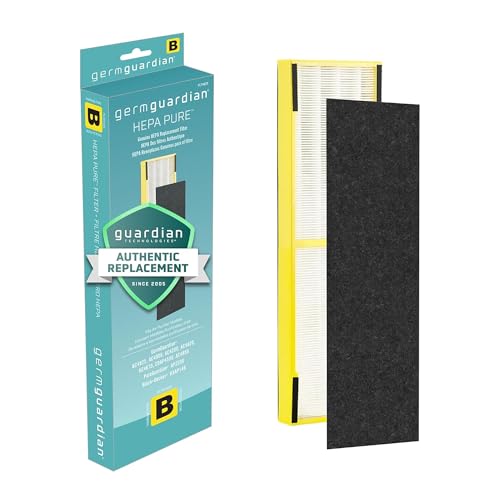
GermGuardian, Filter B HEPA Pure Genuine Air Purifier Filter, Removes 99.97% of Pollutants, Wildfire Smoke, Odors, for Ac4825, Ac4300, Ac4850, Ac4880, Ac4900, Cdap4500, Ap2200, Flt4825
A machine that publishes a real airflow figure, so the arithmetic on this page can actually be applied to it.
Coverage claims vary in what air change rate they assume, so check a published airflow figure against your own room rather than the room size on the box.
| Unit price | Filter price | Unit + 5 years of filters | Filter cost share |
|---|---|---|---|
| $46.98 | $17.98 | $118.90 | 60% |
| $59.95 | $19.66 | $138.59 | 57% |
| $59.97 | $22.99 | $151.93 | 61% |
| $59.97 | $23.98 | $155.89 | 62% |
| $79.99 | $22.99 | $171.95 | 53% |
| $80.74 | $19.88 | $160.26 | 50% |
| $159.95 | $21.37 | $245.43 | 35% |
| $167.96 | $24.99 | $267.92 | 37% |
| $179.99 | $26.99 | $287.95 | 37% |
| $189.99 | $32.88 | $321.51 | 41% |
| $199.99 | $24.99 | $299.95 | 33% |
| $199.99 | $28.79 | $315.15 | 37% |
| $218.50 | $23.99 | $314.46 | 31% |
| $249.99 | $34.99 | $389.95 | 36% |
| $259.99 | $41.99 | $427.95 | 39% |
| $349.00 | $49.99 | $548.96 | 36% |
Why filter costs matter as much as the unit price
When you buy an air purifier, the unit price is only the beginning. The filter is a consumable that must be replaced regularly, usually every 90 days to 12 months depending on use and air quality.
A purifier that costs $60 is cheap to buy, but if the filter costs $24 and you replace it every 12 months, you spend $156 over five years. A $250 purifier with a $35 filter costs $390 over five years. The difference matters if you plan to use the purifier long-term.
The chart shows both the unit price and the total cost after five years of filter replacement, assuming you replace the filter once per year. Most people replace more often (every 90 days), so the true cost is higher.
The filter cost share: cheaper units have higher per-year maintenance
Budget purifiers have a high filter cost share, meaning filters are expensive relative to the unit price. A $60 purifier with a $24 filter has a 62 percent filter share: most of the five-year cost is maintenance, not the initial purchase.
Expensive purifiers have a lower filter share because the filter cost is small compared to the unit price. A $250 purifier with a $35 filter has a 36 percent filter share: the unit is the bigger investment.
This matters if you are deciding between a cheap unit and a mid-range unit. The difference in initial cost might be $100, but the filter cost difference over five years might be only $25. Buying the mid-range unit pays for itself in durability and performance.
Filter replacement intervals and how they affect cost
The chart assumes you replace the filter once per year (12 months). In reality, replacement depends on air quality and usage.
In a home with low air quality (wildfire smoke, cooking, pets), filters load faster and need replacement every 60 to 90 days. This doubles or triples the maintenance cost compared to the chart.
In a home with good air quality and low purifier use, filters last 6 to 12 months. Some people stretch filters to 18 months, which reduces cost but lets efficiency drop.
Check your filter appearance monthly. If it looks gray and clogged, replace it early. A clean filter is cheaper than running a clogged filter, which reduces airflow and forces the motor to work harder.
Why some filters cost more than others
Filter price depends on size, materials, and filtration performance. A large filter (5-inch height) costs more than a small one (1-inch height) because it holds more media.
Multi-stage filters (HEPA plus activated carbon, or HEPA plus pre-filter) cost more than single-stage filters. The extra stages improve performance on odors and small particles.
Replacement filters from brand-name manufacturers (Levoit, WINIX, Coway) cost more than third-party filters. Brand-name filters are usually more reliable and maintain the purifier's performance.
How to lower filter costs over time
Buy larger stock when filters are on sale. If a filter is on Amazon Prime Day or a holiday sale, buy two or three. Filters do not expire, and the savings can be 10 to 20 percent.
Consider a purifier with a longer filter life, if available. Some newer models have thicker filters that last 12 to 18 months instead of 90 days. The higher initial cost pays off in lower maintenance.
Run the purifier on low speed when air quality is moderate. Running on high speed clogs the filter faster. On low or medium speed, filters last longer and cost less over time.
Total cost of ownership vs. performance trade-off
The cheapest purifier ($46 unit, $119 five-year cost) may sound like a bargain, but it might have lower CADR and shorter filter life than a unit that costs $60 more initially.
When comparing two purifiers, calculate the five-year cost before deciding. A $100 difference now might be $60 difference over five years if the more expensive unit has a longer filter life or a more efficient motor.
The best value is often in the $150 to $200 unit price range: enough budget for good HEPA performance and a reasonable filter cost, with less risk than going for the cheapest option.
Equipment mentioned on this page
- Borgodf
Borgodf B-D02L/M05 Replacement Filter for MOOKA B-D02L & M05 Air Purifier
- HEPA claimed
- carbon stage
$17.98 Check pricePrices change often - Sinnya
12020 11020 HEPA Replacement Filter for Clorox Air Purifier 11020 & 11021
- HEPA claimed
$19.66 Check pricePrices change often - Cabiclean
Blue Pure Replacement Filter for Blueair 411, 411+, 411 Auto Air Purifier
- carbon stage
$19.89 Check pricePrices change often - Clorox
Clorox Tabletop Air Purifier True HEPA Replacement Filter, 200 Sq. Ft.
- HEPA claimed
$19.99 Check pricePrices change often - Borgodf
2 Pack HP102 Replacement Filter Compatible with Shark HP102 Air Purifier
- HEPA claimed
- carbon stage
$21.37 Check pricePrices change often - Cabiclean
HPA300 HEPA Filter Replacement for Honeywell, Replace HRF-R3 & HRF-A300
- HEPA claimed
- carbon stage
$21.99 Check pricePrices change often


Common questions
How often should I replace my filter?
Check your filter once a month. Replace it when it looks gray and clogged, which is usually 90 to 120 days of regular use. In homes with heavy air quality issues (pets, cooking, wildfire smoke), replace every 60 days. In clean air, a filter can last 6 to 12 months.
Can I wash and reuse the filter?
No, not for HEPA filters. Washing damages the fibers and destroys the seal, reducing efficiency below 99.97 percent. Some purifiers have a washable pre-filter that catches large dust, but the main HEPA filter must be replaced. Washable HEPA filters exist but are not true HEPA.
Is a third-party filter as good as the brand-name filter?
Quality varies. Some third-party filters are very good; others cut corners and reduce performance. Read reviews and check ASIN numbers. A third-party filter might cost 30 to 40 percent less but could reduce efficiency by 10 to 15 percent. The savings are not always worth it.
Do I need to buy filters from the manufacturer?
No, but check compatibility. A filter must match the exact model number of your purifier. Buying from Amazon or third-party sellers is usually cheaper than the manufacturer website. Just verify the filter ASIN matches your purifier model.
Is the 5-year cost realistic?
The chart assumes once-per-year replacement, which is the minimum in average air quality. In homes with pets, cooking, or wildfire smoke, you will replace more often (every 60 to 90 days), which increases the 5-year cost by 50 to 100 percent. Use the chart as a baseline and multiply by your replacement frequency.