Best air purifiers
Quick answer
The Coway AP-1512HH ($218.50) is the best all-around air purifier: it pairs an auto mode with a washable pre-filter, rated to 1,748 sq ft at the manufacturer's assumed air change rate, and its replacement filter runs $23.99, which keeps the five-year cost lower than most competitors in its class.
A single number cannot tell you what a purifier needs to do in your specific room; use the coverage claim as a starting point, not a guarantee.
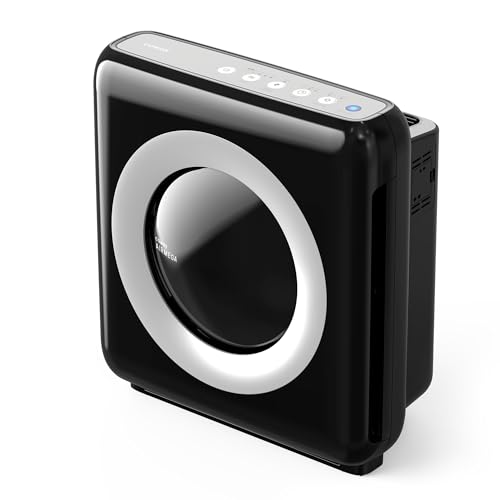
COWAY Air Purifier for Home Up to 1,748ft2, HEPA Filter for Smoke, Allergies, Pet Dander, Odor, Air Quality Monitor, Auto&Eco Mode, Timer, Filter Indicator, 3yr Warranty, Mighty AP-1512HH, Black
Its listing states coverage up to 1,748 sq ft without naming the air change rate behind that figure, so treat it as a ceiling rather than a specification, and the auto mode with a built-in sensor means it does not run at full speed, and full noise, when the air is already clean.
Coverage claims vary in what air change rate they assume, so check a machine's published airflow against your own room rather than the room size on the box.
The three tiers
Beginner: Best first purifier
Who it is for: someone furnishing a bedroom or home office for the first time and does not want to spend past $100

The GermGuardian AC4825 ($99.99) is a true HEPA unit rated to 153 sq ft, with a carbon layer for cooking and pet odor and a genuine replacement filter that runs $19.88, one of the cheapest recurring costs in this whole roundup.
Not for: a living room or open-plan space over roughly 250 sq ft, where its coverage claim runs out fast
Intermediate: Best for a medium to large room
Who it is for: a living room, open-plan kitchen, or a bedroom shared with a home office, up to around 1,700 sq ft at the manufacturer's stated air change rate
- Intermediate pick
LEVOIT Smart Air Purifiers for Home Large Room Up to 1733 Ft2 Core 400S-P
$189.99 Check pricePrices change often

The Levoit Core 400S-P ($189.99) is rated to 1,733 sq ft, runs on app and voice control, and its replacement filter is $42.63, a mid-range recurring cost that matches its mid-range purchase price.
Not for: anyone who wants a washable pre-filter or AHAM-verified numbers, since Levoit publishes its own coverage claim rather than a third-party verified figure
Expert: Best for a large open floor plan
Who it is for: an open-plan living and kitchen area, a finished basement, or anyone who wants headroom well above their actual square footage
- Expert pick
BLUEAIR Air Purifiers for Home Large Room up to 3,235 Ft2, Blue 211i Max
- particle sensor
$349.00 Check pricePrices change often
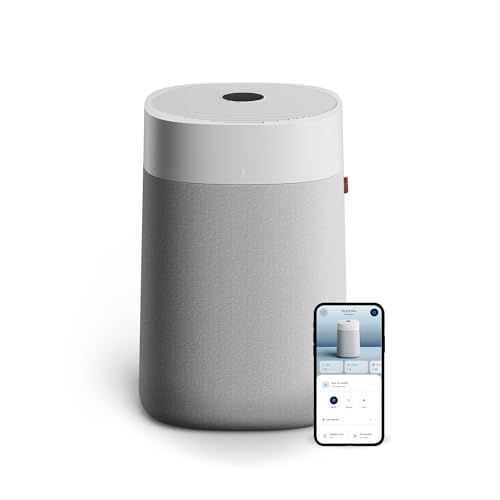
The Blueair Blue 211i Max ($349.00) is rated to 3,235 sq ft, the largest claim in this roundup, which means it can hold a genuinely high air change rate even in a room several times smaller than its rated maximum.
Not for: anyone on a tight budget or furnishing a single bedroom, where this much fan and filter is wasted capacity
| Pick | Room size it suits | What you give up |
|---|---|---|
| Top pick, Coway AP-1512HH | up to roughly 700 sq ft at a real air change rate | higher upfront price than the beginner tier |
| Beginner, GermGuardian AC4825 | a bedroom or home office, up to about 150 sq ft | not enough fan for an open floor plan |
| Intermediate, Levoit Core 400S-P | a living room or medium open space | no third-party verified coverage numbers |
| Expert, Blueair Blue 211i Max | a large open plan or a basement | the highest purchase price in this group |
What actually separates a good air purifier from a bad one at this price
Three things do most of the work: a true HEPA filter stage, a fan strong enough to move a meaningful volume of air through it, and, where odor or off-gassing matters, an activated carbon layer. A machine can advertise a large square footage number and still underperform if the fan cannot push enough air through the filter media to actually clear that volume in a reasonable time.
Look for the AHAM Verifide seal where it exists. It means an accredited lab, not the manufacturer, measured the machine's clean air delivery rate under the AHAM AC-1 standard. Plenty of solid machines skip that certification and publish their own coverage claim instead, which is not automatically dishonest, just a number worth treating with more skepticism.
How to translate square footage into the number that matters
Required airflow in cubic feet per minute works out to floor area multiplied by ceiling height multiplied by air changes per hour, divided by 60. A shopper convention called the two thirds rule fills in an 8 foot ceiling and 5 air changes an hour ahead of time, which reduces to floor area times 0.667, so a 300 sq ft room wants a smoke CADR of at least 200 CFM under that convention.
Five air changes an hour is guidance commonly used for allergy-sensitive households, not a published standard. A household without specific sensitivities can reasonably target 4 air changes an hour and get a smaller, quieter, cheaper machine for the same room.
A taller than average ceiling changes the required airflow even when the floor area stays the same, since the formula multiplies by ceiling height directly. A 9 foot ceiling raises the required CFM by roughly 12.5 percent over an 8 foot ceiling for an identical floor plan, which matters more in an open-plan great room than in a standard bedroom.
Why the coverage claim on the box can be misleading
A manufacturer coverage claim in square feet means nothing without the air change rate it assumes, and that assumption is rarely printed next to the number. The same physical machine can be sold as covering 500 sq ft at 2 air changes an hour and 200 sq ft at 5 air changes an hour, and both numbers would be accurate for their own assumption.
This is why two machines with identical square footage claims can have very different real CADR numbers underneath, and why the coverage figure alone is a poor way to compare two purifiers against each other.
What true HEPA actually guarantees, and what it does not
A true HEPA filter is rated to capture 99.97 percent of particles at 0.3 microns in a single pass through the media, which is a filter-level specification, separate from CADR, which measures the whole machine's output. Some budget listings use the phrase "HEPA-type" or "HEPA-like," which is not the same certification and typically captures less.
None of this is a health claim about symptoms. A purifier reduces the measured concentration of airborne particulate in a room; it does not treat, prevent, or relieve allergies, asthma, or any other condition, and no listing that says otherwise should be trusted on that point.
CADR and HEPA certification also answer different questions. CADR, under the AHAM AC-1 standard, measures the whole machine's output in cubic feet per minute across three particle sizes; true HEPA is a filter-media specification measured separately under a different method. A machine can carry a genuinely high smoke CADR while using a filter medium that is not stated as true HEPA on the listing, and the reverse is possible too.
Ozone, ionizers and UV modes: what the honest answer is
Ozone generators are never the right purifier for an occupied room, and this site does not recommend them. Ionizer and "active" plasma technologies emit ozone as a by-product of how they work, and California's CARB program regulates and certifies indoor air cleaning devices specifically because of that risk.
Several machines in this roundup, including some GermGuardian models, include a UV-C mode alongside their HEPA stage. Where that is true, the mode can be switched off entirely and the true HEPA filtration keeps doing the actual particle removal; a UV or ionizer mode is a marketing add-on, not the mechanism that matters here.
Filter cost is part of the price tag
A replacement filter is a recurring purchase, and it changes which machine is actually cheaper over time. The GermGuardian AC4825 costs $99.99 up front and its filter runs $19.88, while the Levoit Core 400S-P costs $189.99 up front with a $42.63 filter, a gap that only widens with every filter change.
Before buying on price alone, search the specific model number plus "replacement filter" and check what that recurring cost looks like, because a cheaper machine with an expensive filter can cost more over five years than a pricier one with a cheap filter.
The Blueair Blue 211i Max's replacement filter runs $49.99, the highest of the three tiers here, but it is also the tier rated for the most square footage, so the per-square-foot filter cost is not automatically worse than the smaller units; divide the filter price by the coverage claim before assuming the biggest machine is the most expensive one to keep running.
How we chose
These picks come from published manufacturer specifications, AHAM Verifide certification where it exists, and owner reports describing real-world noise and filter life, not in-person testing. Nothing here was measured in a lab or run in our own home.
Preference went to true HEPA filtration with a stated coverage figure over unverified "HEPA-type" claims, and to machines with a documented replacement filter over ones where the recurring cost is unclear.
Buying tips
Do I need AHAM Verifide certification?
Not strictly, but it is the difference between a lab-tested number and a marketing estimate. If two machines are close in price, the one with the seal is the safer bet on the numbers it advertises.
Should I size up past what my room needs?
A little headroom buys a quieter machine, since it can hit your target air change rate at a lower fan speed. A lot of headroom is wasted money and a bigger footprint on the floor.
Does a higher price always mean better filtration?
No. Price often buys app control, sensors, or a larger coverage claim, none of which change the true HEPA filtration itself. Compare the filter stage and the CADR or coverage number before paying for extra electronics.
How often should I actually check my filter?
Check monthly by eye and replace on the manufacturer's stated schedule, sooner with pets, smoking, or a dusty renovation nearby. A visibly gray filter is already past its useful life regardless of the calendar.
Other options worth knowing about
- MOOKA
MOOKA H13 HEPA Air Purifier for Home Pet Large Room Up to 1300ft2, Black
- HEPA claimed
- carbon stage
- has a UV lamp
$46.98 Check pricePrices change often - MOOKA
MOOKA Air Purifiers for Home Room up to 1076ft2, True HEPA Filter, B-D02L
- HEPA claimed
- carbon stage
$49.99 Check pricePrices change often - MOOKA
MOOKA Air Purifiers for Home Room up to 1076ft2, True HEPA Filter, B-D02L
- HEPA claimed
- carbon stage
$49.99 Check pricePrices change often - Clorox
Clorox Small Room Air Purifiers for Bedroom Home, True HEPA Filter
- HEPA claimed
$59.95 Check pricePrices change often - Frida
Frida Baby 3-in-1 Air Purifier, Sound Machine + Nightlight, Auto-Off Timer
- HEPA claimed
$59.97 Check pricePrices change often


Common questions
What is the single best air purifier for most homes?
The Coway AP-1512HH at $218.50 is the strongest all-around pick: its listing states coverage up to 1,748 sq ft at the manufacturer's assumed air change rate, with a washable pre-filter and a genuine replacement filter at $23.99. It suits a living room or open-plan space without the largest, most expensive fan in this roundup.
Is a more expensive air purifier always better?
No. Price frequently buys wifi control, sensors, or a bigger coverage claim rather than better filtration. A $99.99 true HEPA unit like the GermGuardian AC4825 removes the same class of particles as a $349.00 unit; the expensive machine buys more airflow for a bigger room, not cleaner air for a small one.
How many air purifiers does one house need?
A portable air purifier cleans the room it physically sits in, not the whole house, since it has no way to pull air from a closed room down the hall. Most homes need one unit per commonly used room, such as the living room, primary bedroom, and any home office, rather than a single machine expected to cover every square foot, unless the air handling runs through central ducting with its own filter upgrade.
Do air purifiers remove odors as well as particles?
A true HEPA filter alone captures particulate, not gases or odors, since it works by mechanically trapping particles as air passes through the media. Odor control comes from a separate activated carbon layer that adsorbs gas molecules, so a listing that only mentions HEPA and does not mention carbon is unlikely to do much for cooking smells, pet odor, or off-gassing.
Is it safe to run an air purifier with an ionizer or UV mode?
Where that mode can be switched off, running the unit with it off and relying on the true HEPA stage is the more cautious choice, since ionizer and some "active" plasma technologies can emit ozone as a by-product of how they generate charged particles. California's CARB program regulates and certifies indoor air cleaning devices specifically because of that ozone risk in occupied rooms.
Does a bigger coverage number always mean a better machine?
Not on its own. A coverage claim in square feet depends on an assumed air change rate that is rarely stated next to it, so two machines with the same claimed coverage can have very different real airflow. The CADR or a verified certification is the more reliable number to compare.