Best dehumidifiers for a basement
Quick answer
A basement dehumidifier labelled 50 pints under the 2019 DOE test conditions removes roughly what a 70 pint unit did under the old rating; the WHOY (B0FMN5MVTG, $159.98) states both figures directly and covers up to 5,000 square feet.
Compressor dehumidifiers without an auto-defrost feature can ice up and stop working below about 65 degrees, which matters in an unheated basement more than anywhere else in a typical home.

WHOY 80 Pint Dehumidifier for Basement, 50 Pint DOE, Drain Hose, 5000 Sq Ft
The WHOY is labelled both "80 pint" and "50 pint DOE," making the 2019 rating change visible on the listing itself rather than something a shopper has to look up separately. It has a drain hose for continuous drainage and covers a 5,000 square foot claim.
Coverage claims vary in what air change rate they assume, so check a machine's published airflow against your own room rather than the room size on the box.
The three tiers
Beginner: Best for a small or medium basement corner
Who it is for: a small basement, a single damp corner, or a crawl space

The Waykar 34 pint Energy Star unit (B0GT9WCDWK, $165.98) covers a 2,000 square foot claim with a washable pre-filter, sized for a smaller area rather than a full unfinished basement.
Not for: a large or heavily damp basement that needs continuous pump drainage
Intermediate: Best for continuous drainage without emptying a bucket
Who it is for: a basement where nobody wants to empty a reservoir bucket daily
- Intermediate pick
Midea 50 Pint Dehumidifier with Pump, 4,500 Sq. Ft, Energy star
- app or voice
$229.99 Check pricePrices change often

The Midea 50 pint dehumidifier with a built-in pump (B0GL7R3RJV, $229.99) drains continuously through a hose run to a floor drain or up and out a window, covering a 4,500 square foot claim, and reports its status over wifi.
Not for: a basement that regularly drops below 65 degrees in cold weather
Expert: Best for a cold, unheated basement
Who it is for: a basement or crawl space that runs cool or unheated through cold weather

The DuraComfort 50 pint dehumidifier (B0H4Z1MMXG, $249.90) advertises an auto-defrost cycle, which matters because a compressor coil can frost over and stop removing moisture once the room drops below about 65 degrees.
Not for: a basement that stays consistently warm, where the defrost feature adds cost without a benefit
| Tier | Pint rating (DOE where stated) | Drainage |
|---|---|---|
| Beginner (B0GT9WCDWK) | 34 pint, 2,000 sq ft claim | Manual reservoir |
| Intermediate (B0GL7R3RJV) | 50 pint, 4,500 sq ft claim | Built-in pump, continuous |
| Expert (B0H4Z1MMXG) | 50 pint, auto-defrost | Drain hose, continuous |
| Top pick (B0FMN5MVTG) | 80 pint old rating / 50 pint DOE | Drain hose, continuous |
Why do two dehumidifiers with the same pint rating remove different amounts of water?
The pint rating changed in 2019 when the Department of Energy updated the test conditions used to measure it, moving to a lower test temperature and humidity that produces a smaller number for the same physical machine. A unit that would have been rated 70 pints under the old conditions is now labelled closer to 50 pints under the current DOE test, without any change to the hardware inside it, meaning the compressor, coils and fan are all identical to what shipped before the label changed.
This means a chart or review written before 2019, or a shopper comparing an older unit’s box against a new one’s label, will oversize or undersize by a wide margin if the rating basis is not the same on both sides. Checking whether a listing states "DOE" or references the current standard is worth doing before comparing two units by pint number alone, especially when shopping alongside an older printed chart or a review written before the change took effect.
How much water does a basement actually need removed per day?
A basement’s dehumidifier size depends on square footage and how damp the space actually is, from moderately damp up through wet or extremely wet conditions, which this site’s dehumidifier calculator and humidity guides break down by square footage. A 1,000 square foot basement with visible dampness on walls or a musty smell needs meaningfully more daily pint capacity than the same space that just feels slightly humid, even though the two spaces share an identical floor plan.
The picks on this page span a 34 pint unit suited to a smaller or less damp space up through 50 pint units with pumps or hoses for larger or wetter basements. Matching the pint rating, checked against the current DOE basis, to the specific dampness level of the room is more useful than buying the largest available unit by default, since an oversized unit still costs more to run and to buy without adding a benefit the room actually needs.
Why does continuous drainage matter for a basement specifically?
A basement dehumidifier working hard in a genuinely damp space can fill a manual reservoir bucket within a day, and a missed emptying means the unit shuts off and humidity climbs back up until someone notices. A drain hose run to a nearby floor drain, or a built-in pump that can push water up and out through a higher window or sink, removes that daily maintenance step entirely, letting the unit run unattended for as long as the season requires.
This matters more in a basement than almost anywhere else in a home, since basements are the room type most likely to run unattended for days at a time. The Intermediate and Expert tier picks on this page both support continuous drainage for that reason, while the Beginner tier pick is sized for a smaller space where manual emptying is more manageable and less likely to be forgotten for several days in a row.
Does a dehumidifier still work in a cold basement?
A standard compressor dehumidifier pulls air across a cold coil to condense moisture out of it, and that coil can frost over once the surrounding air drops below roughly 65 degrees, which is common in an unheated or partially heated basement, especially through cold weather. Once frost builds up, the unit’s ability to remove moisture drops off even though it may still appear to be running, with the fan spinning and the display lit as if everything is working normally.
An auto-defrost cycle periodically warms the coil to clear that frost buildup, keeping the unit working through colder conditions rather than icing over and stalling. The Expert tier pick on this page specifically advertises this feature, which is the reason it is recommended for a basement that runs cool rather than one that stays consistently warm, where the extra defrost circuitry would rarely, if ever, need to activate.
Does a bigger square footage claim mean a stronger dehumidifier?
Not necessarily on its own. The square footage claims across this page range from 2,000 up to 5,000, but that number reflects the manufacturer’s assumption about how damp the space is as much as it reflects the unit’s pint capacity. Two units with similar pint ratings can carry different square footage claims depending on what dampness level the manufacturer assumed when writing the spec sheet, which is exactly the kind of unstated assumption worth questioning before comparing two listings side by side.
The pint rating, checked against whether it is stated under the current DOE basis, is the more reliable number to compare across brands. Square footage claims are useful for a rough sense of scale but should be read alongside the pint figure rather than instead of it.
Should a basement run a dehumidifier and an air purifier together?
In a basement with any musty smell or visible mold, yes: a dehumidifier addresses the moisture that allows mold to grow, working toward the 30 to 50 percent indoor relative humidity range this site recommends and specifically getting under the 60 percent threshold where mold and dust mites thrive, while a purifier captures spores already circulating in the air.
This site’s mold-focused air purifier review covers that pairing directly. A dehumidifier alone will reduce future mold growth but will not remove spores already suspended in the room’s air; a purifier alone will not stop new growth if humidity stays above 60 percent.
How is a basement dehumidifier different, and does it need to run year-round?
A basement typically has a larger, more open floor plan than a bedroom and often runs at a higher baseline humidity because it sits partly or fully below grade, in contact with soil moisture on the other side of the foundation wall. That combination of larger volume and higher moisture load is why the picks on this page skew toward 34 to 80 pint capacity, well above what a single upstairs bedroom would need.
A basement also frequently lacks the same ventilation a room with operable windows has, since basement windows, where they exist, are smaller and used less often. That makes a dehumidifier’s role more central in a basement than it would be in an upstairs room where opening a window is a viable secondary option for managing humidity.
In most climates, a basement dehumidifier does need to run year-round, since a basement’s below-grade position keeps it in contact with soil moisture regardless of the season, and humidity can spike during humid summer stretches or after heavy rain even when the rest of the house feels dry. A unit with a built-in humidistat, which several picks on this page include, can be set to a target percentage and left running rather than needing manual attention through the year.
Cold weather is when the auto-defrost question in the section above becomes relevant, since a basement that gets genuinely cold in winter needs that feature to keep working, while a milder or partially heated basement can run a standard compressor unit without it through the colder months.
How we chose
Every dehumidifier on this page was researched from published manufacturer specifications and owner reports on retail listings, not from in-person testing of pint output or drainage performance.
Selection prioritized listings that clearly stated a DOE-basis pint rating, continuous drainage options through a hose or pump, and, where relevant to a cold basement, an advertised auto-defrost feature.
Buying tips
How do I know if a pint rating is under the old test or the current DOE one?
Check whether the listing explicitly says "DOE" next to the pint number, or lists two numbers together, such as an old rating alongside a DOE figure. A listing with only one unexplained pint number from an older or unclear source is harder to compare fairly.
Do I need a pump or is a gravity drain hose enough?
A gravity drain hose works if the dehumidifier sits above a floor drain or the hose can run downhill the whole way. A built-in pump is needed to push water uphill, such as up and out a basement window or into a sink above floor level.
Is auto-defrost worth paying extra for?
Only if the basement or crawl space regularly runs below about 65 degrees. In a consistently warm, finished basement, auto-defrost adds cost without addressing a problem that space actually has.
Other options worth knowing about
- Midea
Midea 35 Pint Dehumidifier for Basement, 3,000 Sq. Ft, Energy star
- app or voice
$209.99 Check pricePrices change often - VEAGASO
VEAGASO 34-36 Pint/D, 2500 Sq.Ft Dehumidifier for Basement with Drain Hose
- auto mode
$209.99 Check pricePrices change often - Midea
Midea 50 Pint Dehumidifier for Basement, 4,500 Sq. Ft, Energy star
- app or voice
$219.99 Check pricePrices change often - avylo
avylo Dehumidifier for Basement with Pump and Hose, Max 90 Pints/D, White
$224.69 Check pricePrices change often - Frigidaire
Frigidaire 35 Pint Dehumidifier for Home, Bedroom & Medium Rooms, White
- washable pre-filter
$229.00 Check pricePrices change often - yaufey
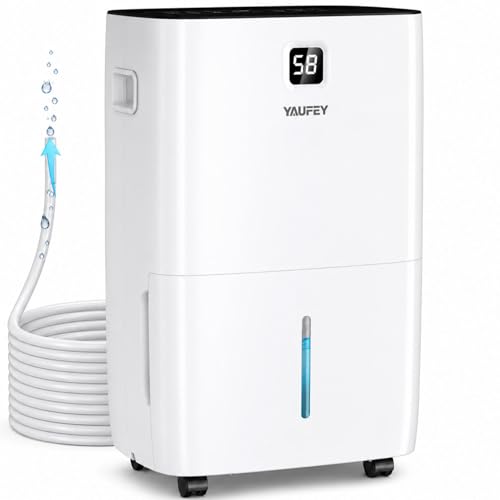
Yaufey 150 Pint Dehumidifier with Pump for Basement 8500 Sq. Ft.
$229.99 Check pricePrices change often


Common questions
Why did dehumidifier pint ratings change in 2019?
The Department of Energy updated the test conditions used to measure pint output, using a lower test temperature and humidity that produces a smaller number for the same physical machine. A unit that would have been labelled 70 pints under the old test conditions is now typically labelled around 50 pints under the current DOE test, with no change to the actual hardware.
How do I compare an old dehumidifier chart against a new dehumidifier’s label?
Check whether the chart or the new label states its pint rating under the current DOE test conditions or the older ones; they are not directly comparable. A reader using an old chart against a new DOE-labelled unit will tend to undersize, since the same real capacity now carries a smaller printed number.
Does a dehumidifier need continuous drainage in a basement?
It is strongly recommended for a genuinely damp basement, since a working unit can fill a manual reservoir bucket within a day and shut off until emptied. A drain hose to a floor drain, or a built-in pump for uphill drainage, keeps the unit running unattended, which matters most in a room type like a basement that often goes unchecked for days.
Will a dehumidifier work in a cold, unheated basement?
A standard compressor dehumidifier can ice up on its cold coil once the surrounding air drops below roughly 65 degrees, reducing or stopping moisture removal. A unit with an auto-defrost cycle periodically clears that frost, letting it keep working through colder conditions, which matters for a basement or crawl space that is not consistently heated.
How big a dehumidifier does my basement actually need?
It depends on both square footage and how damp the space is, from moderately damp up through wet or extremely wet. This site’s dehumidifier calculator accounts for both factors rather than square footage alone, since a visibly damp or musty basement needs meaningfully more pint capacity than the same size room that only feels slightly humid.
Should a damp basement run a dehumidifier, an air purifier, or both?
Both address different parts of the same problem. A dehumidifier lowers relative humidity toward the 30 to 50 percent range that limits mold growth, specifically getting under the 60 percent threshold where mold and dust mites thrive, while a purifier captures mold spores already circulating in the air. Running only one leaves the other half of a musty basement problem unaddressed.