Understanding the US AQI: categories, PM2.5 concentrations, and indoor action levels
Quick answer
The US Air Quality Index breaks air quality into six categories from good (0 to 50 AQI) to hazardous (over 500 AQI). An AQI of 100 equals a PM2.5 concentration of 35 micrograms per cubic meter, the threshold where most people notice air quality is unhealthy.

Frida Baby 3-in-1 Air Purifier, Sound Machine + Nightlight, Auto-Off Timer
A machine that publishes a real airflow figure, so the arithmetic on this page can actually be applied to it.
Coverage claims vary in what air change rate they assume, so check a published airflow figure against your own room rather than the room size on the box.
| AQI | Category | PM2.5 (µg/m³) | Indoor action |
|---|---|---|---|
| 0 to 50 | Good | 0 to 12 | No action needed |
| 51 to 100 | Moderate | 12.1 to 35.4 | Check monitor; consider low speed if you smell pollution |
| 101 to 150 | Unhealthy for Sensitive Groups | 35.5 to 55.4 | Run purifier on medium; keep windows closed |
| 151 to 200 | Unhealthy | 55.5 to 150.4 | Run purifier on high; close windows and doors |
| 201 to 300 | Very Unhealthy | 150.5 to 250.4 | Run purifier on high; stay indoors; minimize exertion |
| 301+ | Hazardous | 250.5+ | Keep indoors; run purifier continuously; consider N95 masks if going outside |
How the AQI is calculated from PM2.5
The AQI is a number from 0 to 500 plus that describes air quality in a single index. It is calculated from six pollutants: ground-level ozone, nitrogen dioxide, sulfur dioxide, carbon monoxide, PM10, and PM2.5. Each pollutant has its own breakpoint scale, and the AQI is the highest of these six.
For indoor air quality, PM2.5 usually dominates the index. Ozone is an outdoor pollutant that does not accumulate indoors when outdoor levels are normal. For PM2.5, the relationship is linear: an AQI of 100 corresponds to 35.4 micrograms per cubic meter of PM2.5.
An air quality monitor that reports only PM2.5 is measuring what matters most indoors. The AQI calculation itself happens in the monitor or on the app that displays the reading. If you see a monitor that shows both PM2.5 concentration and AQI, the AQI should match the PM2.5 value when ozone is near zero.
Good and Moderate: when you might not need a purifier
An AQI below 50 (PM2.5 below 12 micrograms per cubic meter) is good air. Most days in areas without pollution sources, indoor PM2.5 stays in this range if windows are closed. You do not need to run a purifier.
Moderate air (AQI 51 to 100, PM2.5 12 to 35 micrograms) is fine for most people. If you have allergies or asthma, or if you can smell pollution like cooking smoke, this is when to turn on a purifier. Running it on low speed is usually enough.
Unhealthy for Sensitive Groups: when to start acting
At AQI 101 to 150, anyone with asthma, allergies, or heart disease should run a purifier. This includes children and older adults. PM2.5 at 35 to 55 micrograms is when most people notice the air is not clear.
At this level, close your windows and run the purifier on medium speed. If the source is cooking or wildfire smoke, running on high is more effective. The goal is to reduce indoor PM2.5 to below the moderate threshold before the pollution peaks, because once PM2.5 builds up, it takes longer to clear.
Unhealthy and Very Unhealthy: severe outdoor pollution
At AQI 151 and above, outdoor air is dangerous. This usually happens during wildfire season or in rare pollution events in cities. At this level, close all windows and doors, run your purifier on high, and avoid outdoor activity.
Very Unhealthy air (AQI 201 to 300) is rare except during major wildfires. Hazardous air (AQI above 300) is extreme. If you live in a region where outdoor PM2.5 reaches these levels, you need a purifier large enough to handle your space: undersizing will not keep up with infiltration.
Indoor PM2.5 when windows are closed
Even with windows and doors closed, outdoor PM2.5 will eventually reach your indoor air. The rate depends on air tightness, infiltration area, and time. In a typical home, indoor PM2.5 can reach 50 to 70 percent of outdoor levels within a few hours of closed windows.
A purifier running on high can prevent this buildup. Running high for two hours when outdoor AQI is unhealthy, then switching to low, is more effective than letting indoor levels climb all day. The key is early action: once PM2.5 builds up to 100+ micrograms indoors, it takes hours to clear even with a strong purifier running.
Equipment mentioned on this page
- GoveeLife
GoveeLife Smart Air Quality Monitor with PM2.5 H5106, LED Display Wired
- app or voice
$45.99 Check pricePrices change often - Clorox
Clorox Small Room Air Purifiers for Bedroom Home, True HEPA Filter
- HEPA claimed
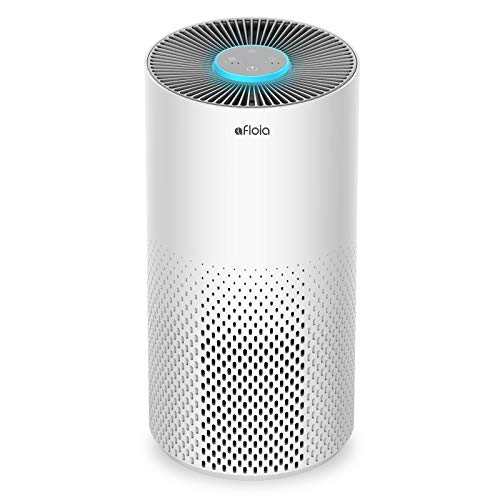
$59.95 Check pricePrices change often - Afloia
Afloia Air Purifier for Home Bedroom Large Room up to 1500 Sq Ft
- washable pre-filter
$59.97 Check pricePrices change often - Afloia
Afloia Air Purifier for Home Bedroom Large Room up to 1076 Sq Ft
$69.98 Check pricePrices change often




Common questions
Is AQI the same everywhere?
The US AQI uses the same breakpoint scale nationwide, but the actual AQI number at your location depends on local monitoring stations. Outdoor AQI data comes from EPA and local air quality agencies and is specific to your region. Indoor AQI is whatever your monitor measures in your room.
My monitor shows PM2.5 of 25. What is the AQI?
PM2.5 of 25 micrograms per cubic meter is approximately AQI 75, in the moderate range. The exact relationship is: AQI = 50 times (PM2.5 / 35.4) when PM2.5 is between 12 and 35. Your monitor may calculate this for you.
Should I always keep my purifier running?
Running a purifier continuously is not necessary if outdoor air quality is good and you keep windows closed. The main benefit is during wildfire season, high pollen days, or when outdoor air quality is moderate or worse. Running it 4 to 8 hours a day during poor air quality is more cost-effective than all-day use.
Why do I need to close windows when AQI is unhealthy?
Open windows allow outdoor PM2.5 to enter directly. Closing windows slows the infiltration to a few percent per hour, giving your purifier time to keep up. If windows are open and outdoor AQI is 200, your indoor air will match outdoor air within minutes.
Does AQI include pollen?
The six pollutants in the AQI do not include pollen. Pollen is counted in PM10 if it is that size, but pollen concentration is tracked separately by allergy services. If you see a pollen count, that is a different measurement from AQI.