Best air purifiers for a large room
Quick answer
For a room between 400 and 900 sq ft, the Winix 5510 ($179.99) is the pick: it is rated to 1,881 sq ft at the manufacturer's assumed air change rate, which leaves enough headroom to hit 4 to 5 air changes an hour in a 700 sq ft living room rather than just barely reaching it.
A large room needs a machine rated well past its actual square footage, since a coverage claim right at the room size usually assumes a low, undemanding air change rate.

WINIX 5510 Air Purifier (New Generation of 5500-2 with App Support) for Home Large Room Up to 1881 Ft2 in 1 Hr, True HEPA, High Deodorization Carbon Filter and Auto Mode, Captures Pet Allergies, Smoke
It pairs a true HEPA filter with a real-time air quality sensor and an auto mode, so it runs quiet when the sensor reads clean air and ramps up on its own when it does not, which matters more in a large room than a small one.
Coverage claims vary in what air change rate they assume, so check a machine's published airflow against your own room rather than the room size on the box.
The three tiers
Beginner: Best budget pick for a large room
Who it is for: someone furnishing a 400 to 600 sq ft space on a tight budget
- Beginner pick
MOOKA H13 HEPA Air Purifier for Home Pet Large Room Up to 1300ft2, Black
- HEPA claimed
- carbon stage
- has a UV lamp
$46.98 Check pricePrices change often

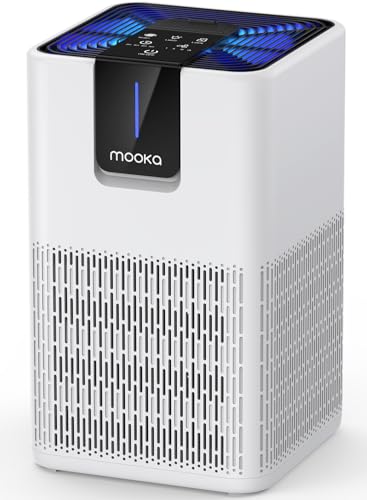
The MOOKA H13 ($46.98) is rated to 1,300 sq ft, has a true HEPA stage plus carbon, and its replacement filter is $17.98, one of the cheapest recurring costs of any large-room unit in the catalog.
Not for: anyone who wants a real-time sensor or app control, since this is a manual-speed machine with no smart features
Intermediate: Best for a long filter interval
Who it is for: a household that does not want to think about filter changes for years at a time
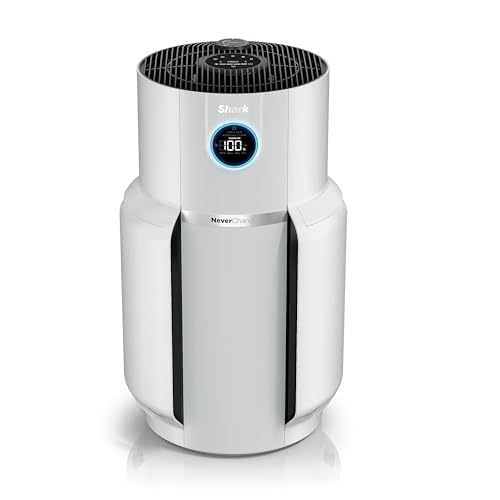
The Shark R-HP302 ($219.99) is rated to 1,400 sq ft and is built around a 5 year filter life claim, which trades a higher upfront filter design cost for far fewer replacement purchases.
Not for: anyone who wants the lowest possible replacement filter price, since a long-life filter typically costs more per unit than a standard one
Expert: Best for the top of the range, 700 to 900 sq ft
Who it is for: an open-plan living and dining area, or a large bedroom plus sitting room combination

The Medify MA-40 ($249.99) is rated to 1,793 sq ft with a true HEPA filter and no ionizer or UV mode at all, meaning every dollar of that rating comes from filtration rather than an add-on technology.
Not for: a room under 400 sq ft, where this much fan is more machine, and more noise, than the space needs
| Floor area | Required CFM at 8 ft ceiling | Required CFM at 9 ft ceiling |
|---|---|---|
| 400 sq ft | 267 CFM | 300 CFM |
| 600 sq ft | 400 CFM | 450 CFM |
| 700 sq ft | 467 CFM | 525 CFM |
| 900 sq ft | 600 CFM | 675 CFM |
Why a large room needs more headroom than the coverage number suggests
A manufacturer coverage claim in square feet assumes a specific air change rate, and that assumption is almost never printed next to the number. A machine rated to exactly 700 sq ft might be assuming as few as 2 air changes an hour at that size, which is a low bar for a room where several people spend hours at a time.
Buying a machine rated to roughly double the room's actual floor area is the more reliable way to guarantee 4 to 5 air changes an hour, since that guidance figure requires more airflow than most bare-minimum coverage claims assume.
The arithmetic behind the table above
Required CADR in CFM equals floor area multiplied by ceiling height multiplied by air changes per hour, divided by 60. At an 8 foot ceiling and 5 air changes an hour, that reduces to floor area times 0.667, which is the two thirds rule, a shopper convention rather than a published standard. A 9 foot ceiling raises the required airflow by roughly 12.5 percent for the same floor area.
Five air changes an hour is guidance for allergy-sensitive households, not a regulation. A household without specific sensitivities can reasonably target 4 air changes an hour, which lowers every number in that table by about 20 percent.
What the smoke CADR number tells you that the coverage claim does not
Under the AHAM AC-1 standard, a purifier carries three separate CADR numbers for smoke, dust, and pollen, measured in a sealed 1,008 cubic foot chamber. Smoke particles are the smallest of the three and usually produce the lowest number, which makes it the most conservative figure to size against if wildfire smoke, cooking smoke, or cigarette smoke is the actual concern in a large room.
Where a listing only advertises a coverage claim in square feet with no CADR figure attached, treat that number as unverified marketing rather than a lab result, and lean toward the higher end of the sizing range in the table above.
Noise at the speed a large room actually needs
A decibel figure printed on the box is almost always measured at the lowest fan speed, not the speed required to actually deliver the rated airflow in a 700 or 900 sq ft room. A large-room machine running near its top speed to hit a real air change rate will be noticeably louder than its lowest published number.
A unit with an automatic mode driven by a real air quality sensor, like the Winix 5510, spends most of its time at a lower, quieter speed and only ramps up when the sensor detects a real spike, which matters more in a room people actually sit in for hours.
Ozone, ionizers and UV in large-room machines
None of the three tiers above run an ionizer or a UV mode; all three rely on true HEPA filtration alone. Some large-room machines on the market do include an ionizer or an "active" plasma mode, and where that is the case, the mode should be switched off and the true HEPA filter left to do the actual particle removal, since ionizer technologies emit ozone as a by-product and California's CARB program regulates indoor air cleaning devices specifically on that basis.
This is not a claim that any specific product in this roundup emits ozone; none of the three carries that technology at all. It is a general rule for the large-room category, where higher-output "whole room" and "wildfire" marketing sometimes leans on ionizer or plasma add-ons that a shopper should be able to recognize and switch off regardless of which brand carries them.
Filter cost matters more in a large-room machine, not less
A large-room purifier runs its fan longer and harder than a bedroom unit to hold a real air change rate across more square footage, which shortens filter life in practice even when the stated replacement interval is the same. The MOOKA's $17.98 filter and the Medify MA-40's $34.99 filter represent very different five-year costs once that faster wear is factored in.
The Shark R-HP302's 5 year filter design is the outlier of the three: instead of a cheap filter changed often, it is built around a single, more durable filter changed rarely, which shifts the cost comparison from a per-filter price to a per-year price across the filter's full rated life.
How we chose
These picks are drawn from published manufacturer coverage claims, AHAM Verifide certification where a machine carries it, and owner reports describing real noise levels and filter longevity, not in-person testing or lab measurement.
Preference went to machines rated to at least double the room size under discussion, since that headroom is what actually delivers 4 to 5 air changes an hour rather than a bare-minimum coverage claim.
Buying tips
Should I buy for my room size or double it?
Buy for roughly double your actual floor area if you want a real air change rate rather than a low one. A machine rated exactly to your square footage is usually assuming the lowest air change rate the manufacturer could reasonably claim.
Does one large-capacity machine beat two smaller ones?
For a single open room, one large-capacity machine is usually simpler and cheaper to run than two smaller units, since it needs one filter change instead of two. For separate rooms, individual machines still make more sense.
Is a 5 year filter claim worth the higher price?
It can be, if the machine's replacement filter costs less per year than a standard filter changed on a normal schedule. Compare the filter price divided by its rated life against a standard unit's filter price divided by 6 to 12 months.
What if my large room has an open floor plan into a hallway?
An open floor plan effectively increases the volume the machine has to clean, since air moves freely between the spaces. Size toward the top of the range in the table above rather than the middle.
Other options worth knowing about
- MOOKA
MOOKA Air Purifiers for Home Room up to 1076ft2, True HEPA Filter, B-D02L
- HEPA claimed
- carbon stage
$49.99 Check pricePrices change often - MOOKA
MOOKA Air Purifiers for Home Room up to 1076ft2, True HEPA Filter, B-D02L
- HEPA claimed
- carbon stage
$49.99 Check pricePrices change often - MOOKA
Air Purifiers for Home Large Room 1250 Ft2, MOOKA H13 HEPA Filter M05 White
- HEPA claimed
$66.63 Check pricePrices change often



Common questions
What is the best air purifier for a 700 sq ft room?
The Winix 5510 ($179.99), rated to 1,881 sq ft at the manufacturer's assumed air change rate, gives a 700 sq ft room enough headroom to run at 4 to 5 air changes an hour rather than the bare minimum a machine rated closer to 700 sq ft would deliver. Its real-time sensor also keeps it quiet when the air is already clean.
How much bigger should a purifier's rating be than my room?
A common approach is to buy a machine rated to roughly double your actual floor area, since coverage claims often assume a low air change rate at the stated maximum. Doubling the rating gives enough margin to reach 4 to 5 air changes an hour, the guidance figure commonly used for allergy-sensitive households.
Do I need one big machine or two smaller ones for a large open room?
For a single connected space, one large-capacity machine is usually simpler, since it needs one filter change on one schedule instead of two separate schedules for two machines. Two smaller machines make more sense once the space is actually split into separate rooms with doors between them, since a single purifier cannot pull air through a closed door.
Is a machine with a 5 year filter actually cheaper long term?
Sometimes. Divide the filter price by its rated life in years and compare that to a standard filter's price divided by its replacement interval, usually 6 to 12 months. A long-life filter wins when its per-year cost comes out lower, not automatically just because the filter itself lasts longer between changes.
Will a large-room purifier be too loud for a living space?
At the fan speed that actually delivers its rated airflow, yes, it will be louder than its lowest published decibel figure, since that number is usually measured at the quietest available speed rather than the speed that produces the advertised coverage. A machine with an automatic sensor mode spends more time at lower speeds and only ramps up when the sensor detects a real spike in particulate.
Does an activated carbon layer matter for a large room?
Yes, more than for a small one, since a larger space usually has more sources of cooking odor, pet odor, or off-gassing spread across it. A true HEPA filter alone captures particulate, not gases or smells; activated carbon is the separate stage that adsorbs those gas molecules, which is why all three tiers in this roundup include it alongside true HEPA filtration.